Ever since my husband died, life had been one long struggle to stay afloat. Cancer took him slowly, and the treatment costs took everything else. By the time it was over, we were drowning in debt, and it fell to me and my ten-year-old daughter, Mia, to figure out how to survive the life that was left behind. I worked as a cashier at a grocery store, counted every dollar twice, and tried not to let Mia see how often I worried. So when I finally managed to save enough to buy her a brand-new pair of boots, it felt like a tiny victory in a life that didn’t offer many.
She was so happy when I gave them to her. She wore them home that day, and I remember thinking that maybe, just maybe, I had done something right. But the next afternoon, she came home from school wearing her old sneakers instead. My heart dropped the moment I saw them. “Mia, where are your new boots?” I asked. She looked down at the floor and mumbled that a new girl in her class, Ruby, had shoes full of holes. She said she felt sorry for her and gave her the boots. I should have been upset, because I had worked so hard to buy those boots, but instead I felt this fierce, aching pride. My daughter had a heart bigger than our bank account, and that meant something.
- My Daughter in Law Gave Me a 2 Scratch Ticket for My 73rd Birthday She Never Knew It Was Worth Millions
PART 3I slowly set down my coffee. “I know what?” He pointed to the signature. “T&E Property Holdings.” I […]
- Lady Slammed Me for My Crying Baby at a Grocery Store, She Turned Red When She Heard My Reply
A man noticed a lady following him in the grocery store for a few minutes. He had gone there to grab some stuff with […]
The next morning, I sent Mia to school in her old shoes and went to work like usual, trying to tell myself I would figure out how to buy another pair later. About an hour into my shift, my phone rang. It was the school principal, and his voice sounded tense in a way that immediately made my stomach knot. “Mrs. Carter, please come to the school right away,” he said. “We found something in Mia’s locker.” I froze. “What do you mean, found something?” He didn’t answer that directly. He only said, “You need to see it with your own eyes.”
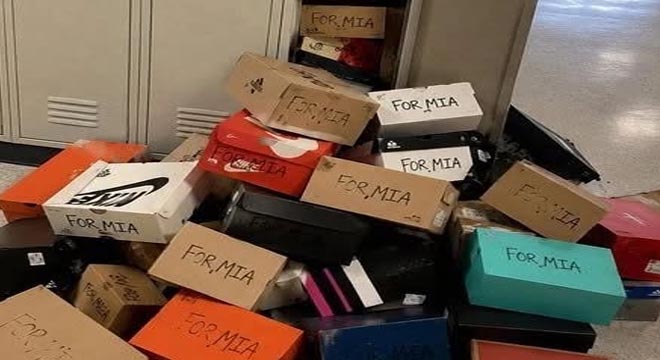
I rushed out of work and drove straight to the school, my mind spinning the whole way. When I got there, several teachers were already standing near Mia’s locker, along with the principal. And on the floor in front of it was a pile of shoeboxes. Dozens of them. Maybe more. Every single one had the same words written across the top in black marker: FOR MIA. My hands trembled as I crouched down and picked up the nearest box. Mia stood beside me, looking just as confused as I felt. I opened the lid, and the first thing I saw made me stop breathing.
It wasn’t shoes. It was money.
Stacks of bills. Neatly bundled envelopes. Cash in amounts I couldn’t even process at first. Mia gasped beside me, and I opened another box, then another, then another, each one filled with more money. My knees nearly gave out. One of the boxes held a handwritten note, and with shaking fingers, I unfolded it. The message was short, but it changed the entire room: Your daughter gave my granddaughter her boots. You taught her to be that kind. Please allow the rest of us to help.
I looked up in shock, and that’s when I saw the woman standing near the front office. She was elderly, dressed neatly, and beside her stood a little girl I instantly recognized from Mia’s story. Ruby. The new student. Ruby’s grandmother walked over with tears in her eyes and explained that Ruby’s family had lost nearly everything in a house fire, including clothing and shoes. When Ruby came home wearing Mia’s boots, she told her family what had happened. Someone in the community posted about it, and the story spread fast. Neighbors, businesses, church groups, and strangers had started dropping off donations at the school all morning.
The principal gave a small, stunned laugh and said they’d had to stop accepting boxes after the first hour. I stared at the mountain of shoeboxes and felt tears blur my vision, not because of the money itself, but because of what it meant. For years, it had felt like life only knew how to take from us. First my husband. Then our savings. Then our sense of safety. But standing there in that school hallway, with my daughter beside me, I saw something I hadn’t expected to find again: proof that kindness can grow. Mia had given away one pair of boots, and somehow that one small act had brought an entire community to its feet.
Ruby hugged Mia before we left, and Mia hugged her back like they had known each other forever. As we headed out, Ruby’s grandmother thanked us again and again, but Mia just shook her head and said, “My dad always said if you have enough to share, you should share it.” I looked up fast, because those were exactly the kind of words her father used to say. And for the first time in a very long while, instead of feeling like he was gone, I felt like he was still finding ways to take care of us.