After our last argument, my son disappeared from my life.
Not just physically. Completely.
No calls. No birthday cards. No Christmas visits. Not even one short message to say, I’m alive, Mom.
- My Daughter in Law Gave Me a 2 Scratch Ticket for My 73rd Birthday She Never Knew It Was Worth Millions
PART 3I slowly set down my coffee. “I know what?” He pointed to the signature. “T&E Property Holdings.” I […]
- Lady Slammed Me for My Crying Baby at a Grocery Store, She Turned Red When She Heard My Reply
A man noticed a lady following him in the grocery store for a few minutes. He had gone there to grab some stuff with […]
For the first few years, I waited.
Every time the bakery door opened, my heart jumped before my mind could stop it. Every time the phone rang after closing, I imagined his voice on the other end, awkward and guarded, saying, “Hi, Mom.”
But hope is a strange thing. It doesn’t die all at once. It thins. It fades. It becomes something you stop feeding because feeding it hurts too much.
By the tenth year, I had trained myself not to expect him anymore.
My bakery became my life instead.
Rosemary’s Bakery sat on the corner of Maple Street, tucked between a flower shop and an old bookstore. Every morning before sunrise, I rolled dough, mixed batter, brewed coffee, and filled the display case with croissants, pies, muffins, and the cinnamon rolls my son had once loved more than anything in the world.
When he was little, he used to sit on the counter with flour on his cheeks, swinging his legs while I glazed them.
“Extra frosting, Mom,” he would beg.
“You’ll spoil your dinner.”
“I’ll risk it.”
Those memories were dangerous, so I kept them locked away.
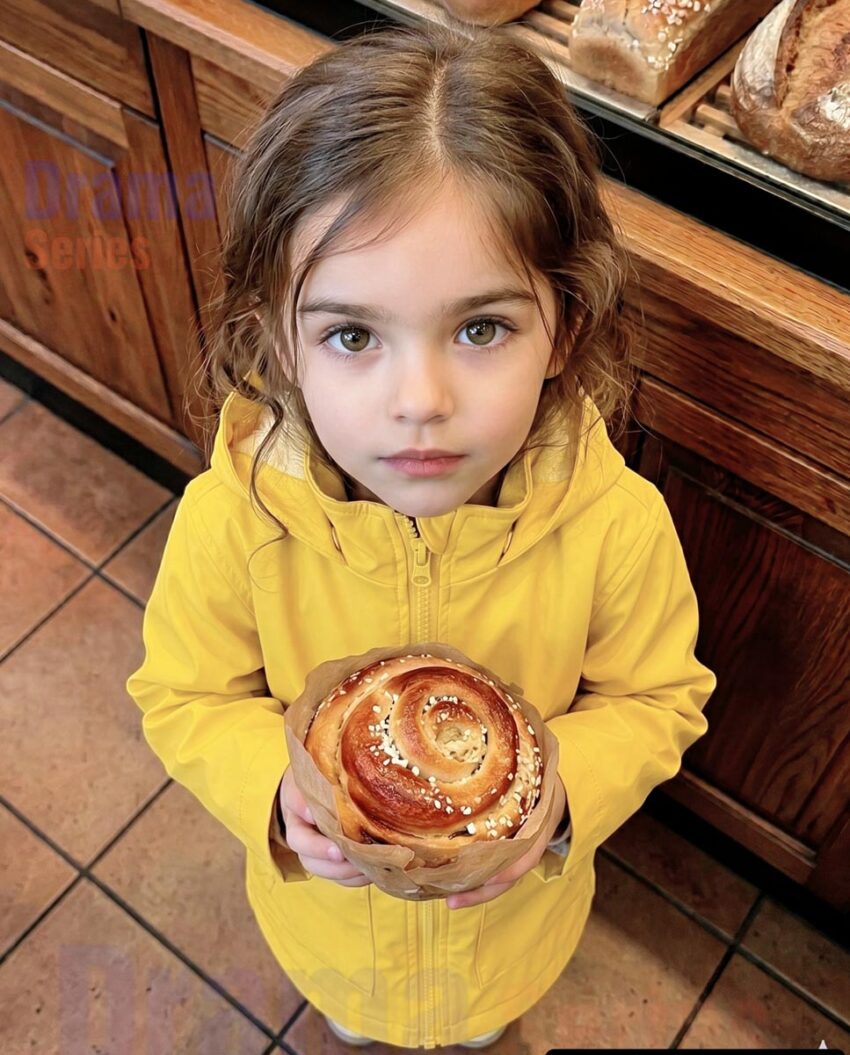
Then, three weeks ago, a little girl in a yellow raincoat walked into my bakery at exactly four o’clock.
She couldn’t have been more than nine. Her brown hair was tied in two messy braids, her backpack looked too heavy for her small shoulders, and her eyes—
Her eyes nearly made me drop the tray in my hands.
They were my son’s eyes.
Deep brown, bright, stubborn, and sad around the edges.
She walked straight to the counter, stood on her toes, and said, “Two cinnamon rolls, please.”
I smiled, though my chest had tightened. “Big appetite?”
“One is for me,” she said. “One is for my dad.”
My fingers froze on the ribbon.
I wanted to ask his name. I wanted to ask where he lived, whether he had brown hair, whether he had a scar above his eyebrow from falling off a bike at age seven.
Instead, I only said, “Tell your dad thank you.”
The little girl nodded, paid with crumpled bills and coins, and skipped out into the rain.
I told myself it meant nothing.