
The day my husband walked out after my stroke, I truly believed my life had ended in every way that mattered. Not just because my body had changed overnight, but because the person I thought would be my anchor had slowly become someone I didn’t recognize at all. At first, he promised he would stay. He held my hand in the hospital, told me we would get through it together, that nothing could shake what we had built over the years. I wanted to believe him more than anything.
But recovery isn’t a straight line, and neither is patience.
- Joan Collins Stuns Fans With a Rare Red Carpet Appearance at 92

Actress Joan Collins once again demonstrated why she remains one of the most admired figures in the entertainment […]
- I Moved My Wedding to the Hospital Because My Father Was Hospitalized Shortly Before the Wedding – But After the Ceremony, a Nurse Pulled Me Aside and Said, ‘Your Father Is Lying to You’
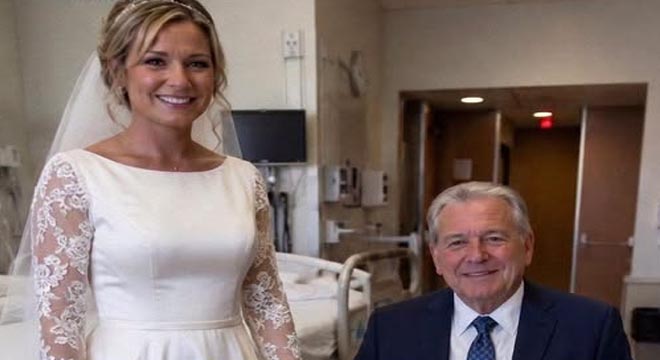
The invitations were mailed, the venue was paid for, and my dress was hanging perfectly in my closet. I was exactly […]
As weeks turned into months, his visits became shorter. Then they became excuses. Work was busy. Traffic was bad. He was tired. I told myself those were normal reasons, but I started noticing the pattern too clearly to ignore. He stopped sitting long enough to talk. He stopped asking about therapy. Eventually, he stopped asking about me at all.
One afternoon, I watched him pack a suitcase in silence. No argument, no dramatic confession at first—just methodical folding, like he had already rehearsed the moment many times before. When I asked him where he was going, he didn’t even look at me right away. He just said he couldn’t do this anymore. A few weeks later, I found out there was another woman. That was the part that hurt differently—not just the leaving, but the replacement, as if everything we had built could be exchanged so easily.
For a long time after that, I thought my life had truly ended. Not because of the stroke alone, but because the future I had built around him had collapsed in one quiet, careless exit. I spent days in silence, staring at walls, trying to understand how someone could promise forever and still leave halfway through the hardest chapter.
But something unexpected happened in the middle of all that darkness: I didn’t stop.
Physical therapy became my new routine, then my responsibility, and eventually my lifeline. Every movement felt like a negotiation with my own body. Standing up felt impossible at first. Walking felt like a memory I couldn’t quite reach. But little by little, with bruises, setbacks, frustration, and small victories no one else could see, I started reclaiming pieces of myself. Not all at once. Not dramatically. Just slowly enough that I almost didn’t notice it happening.
Then, exactly one year after he left, a donation truck pulled up outside my house.
I turned slowly, and my breath caught instantly.
It was him.
My ex-husband stepped out of the car, his expression shifting from confusion to shock as he saw the donation truck, the boxes, and me standing there steady on my feet in a way he clearly hadn’t expected. His eyes moved toward the curb again, and that was when everything in his face broke apart.
Because he finally understood what I was letting go of.
And for the first time since the day he left, I saw him cry—not out of anger, not out of excuses, but out of realization that I hadn’t just survived without him.
I had rebuilt myself without the life he assumed I could never live again.